

Some Rather Bizarre Sunscreen Drama

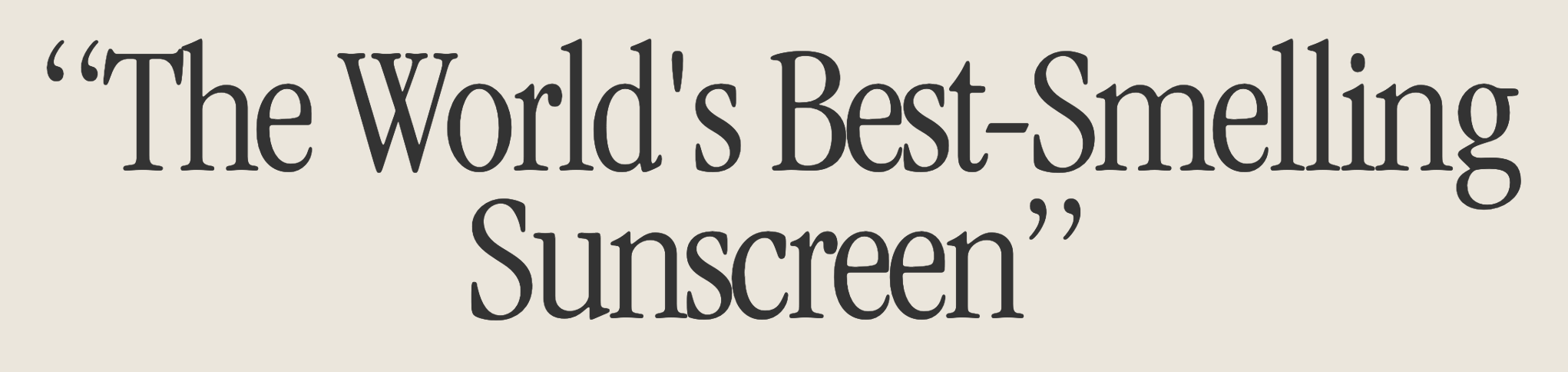
If you know anything about Vacation, the retro-themed sunscreen brand, it’s probably their tagline: the “World’s Best-Smelling Sunscreen.” It does smell fabulous—a mix of banana, pool water and swimsuit fabric, developed with ARQUISTE Parfumeur, known for niche scents.
The “best-smelling” tagline is clearly more opinion than an actual title, just like the breakfast spot over off of Hauser and Beverly has the “World’s Best Cup of Coffee.” (Don’t tell Buddy the Elf.) Yet something odd happened to land in my inbox this week.
The National Advertising Division (NAD) of National BBB Programs—an independently operated and self-regulated nonprofit that works to ensure a “more trustworthy marketplace” (and is NOT affiliated with the Better Business Bureau) sent out a press release, sharing that Vacation’s claim of being the “best-smelling sunscreen” on the market was investigated.
“BBB National Programs’ National Advertising Division (NAD) reviewed a challenge to Vacation, Inc.’s claim that it offers the ‘World’s Best-Smelling Sunscreen.’ NAD determined that when the claim appears on its own—such as on product packaging or retail displays—consumers are likely to view it as opinion or advertising exaggeration, not a factual statement. However, when presented on the company’s website alongside star ratings and consumer reviews, the claim could reasonably be interpreted as being supported by evidence. NAD therefore recommended that Vacation modify how the claim appears online to avoid conveying that it is substantiated by reviews.”
Because of this, NAD determined the claim should be modified. The challenge of the statement was made by Beiersdorf, the German beauty conglomerate with sunscreen brands like Coopertone and Eucerin (and others such as Aquaphor, La Prairie, Nivea and Chantecaille).
“Beiersdorf argued Vacation cannot support its ‘World’s Best-Smelling Sunscreen’ claim, while Vacation argued that the claim is puffery,” the press release states. “The claim appears on product labels, in retail signage, social media, and Vacation’s website.”
NAD did clarify that the tagline is subjective and clearly an exaggeration, stating that they “found that reasonable consumers are unlikely to view the claim when presented by itself, as objective requiring substantiation,” and that when appearing on retail signage and on the product label wasn’t an issue.
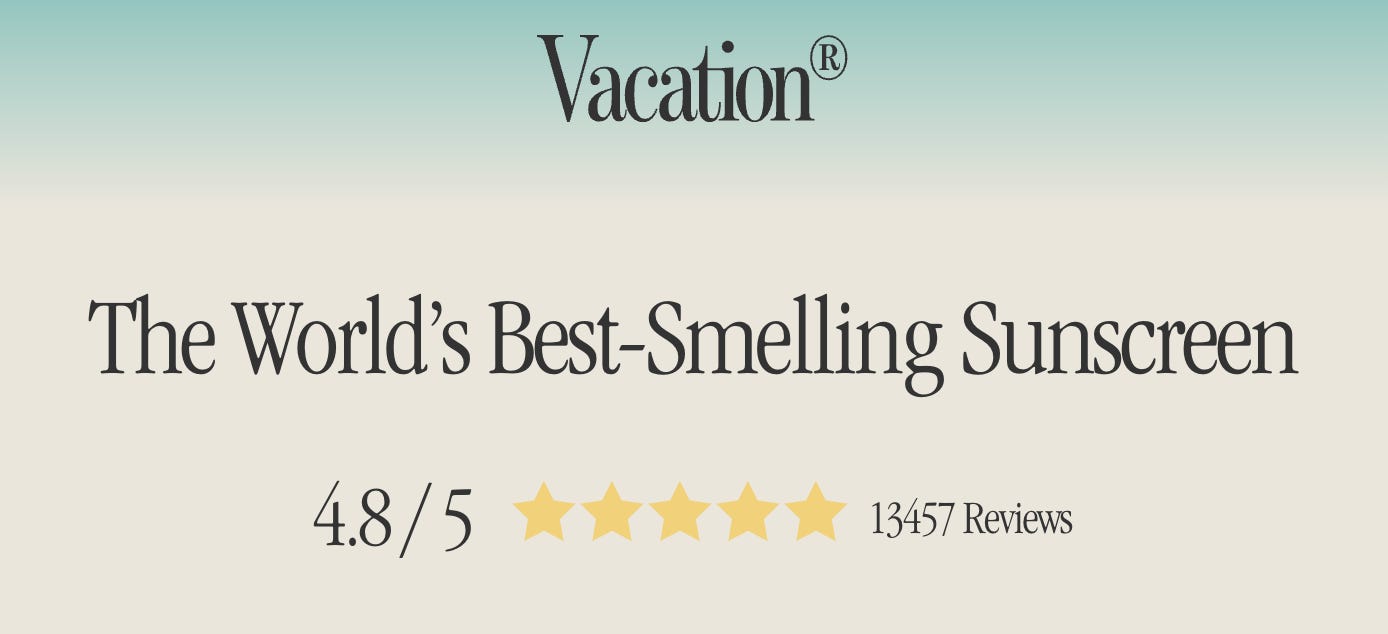
But when it came to the website, NAD took issue with the claim which appears in quotation marks and is displayed immediately above five stars, with “4.8/5.0” and “13,457 Reviews” immediately below. “NAD determined that, in this context, consumers may take away the message that the claim is more than puffery and relies on reviews as substantiation for a claim of preference,” the statement says. Because of this, they recommend that Vacation modify its advertising on the website so that consumers would not feel the message was substantiated by actual reviews.
I think we’ve taken it a tad far here. Or maybe not far enough? Given this country is in a stark literacy crisis, where people seem to take everything in the most literal way possible, perhaps NAD is just doing what needs to be done. Sadly, it means in-jest marketing campaigns are going to be nit-picked to death. Was there a challenge with CeraVe’s Michael Cera campaign? Surely people understood he wasn’t actually claiming to have created the brand, right? (Right?!)
Love me some Eucerin sunscreen (I stock up when I travel abroad) but this challenge from Beirsdorf is… weird? Embarassing? Juvenile? Of course Vacation cannot support the overall claim in a literal sense. Fragrance is subjective to your personal preferences.
The brand did remove it from quotes in the review section, while kept it in quotes in others. The quote could be validated by simply taking one person’s review and promoting it. It would not be indicative of everyone in the world, but would still be factual. So I’m struggling to see how any of this vernacular (or punctuation) is problematic to the consumer. Especially since everyone on Al Gore’s internet is quick to assume anything posted at all is an ad.
I must believe we’re smart enough to decipher an exaggerated marketing message like this versus a verified claim.
Similar to Vacation’s tagline, it seems as if NAD’s “recommendations” are merely guidance and opinion versus an actual verdict with implications and/or punishments.
What do you think? Is this a helpful suggestion to protect consumers? Or is it a bogus challenge from a competitor?
I'd feel differently if the tagline was 'the world's most protective sunscreen', but best-smelling is so subjective I immediately think it's humorous marketing. Although I also worry about where critical thinking skills are headed in 2026.
I gotta say this is too far. I get what NAD is doing, and given the literacy crisis, maybe needed. But we need to instead encourage critical thinking. As consumers, we should be able to discern this is a marketing message, not a statement of fact. To your point, scent is inherently subjective. If Vacation wants their value prop to be "best smelling sunscreen," that is perfectly reasonable and fine!! Brands need to be able to have fun with their messaging. If we were to live in a totally literal world, that would be a very boring place!